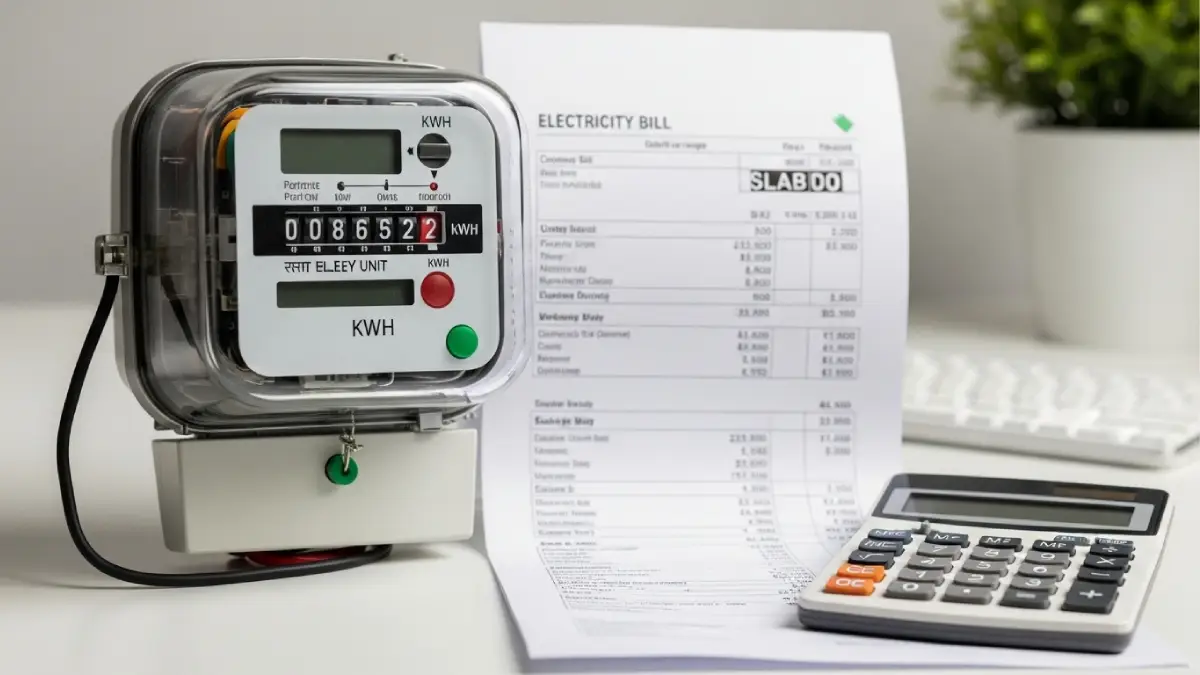
Knowing how to calculate your electricity bill from a meter reading can help you understand your monthly power consumption and estimate your upcoming bill. You do not always need to wait for the electricity company to generate your bill. By checking your previous and current meter readings, you can calculate the number of units (kWh) you have consumed and get a reasonable estimate of your electricity charges.
The basic calculation is simple:
Electricity Units Consumed = Current Meter Reading − Previous Meter Reading
However, the final electricity bill may include more than just the cost of electricity units. Depending on your electricity provider and tariff plan, your bill may also include fixed charges, meter charges, taxes, electricity duty, fuel adjustment charges, and other applicable fees.
In this guide, you will learn how to calculate an electricity bill from meter reading step by step, with practical examples.
What Is an Electricity Meter Reading?
An electricity meter records the amount of electrical energy consumed by a property. Modern digital electricity meters generally display consumption in kilowatt-hours (kWh).
One kilowatt-hour is commonly called one unit of electricity.
For example:
- 1 kWh = 1 electricity unit
- 10 kWh = 10 electricity units
- 100 kWh = 100 electricity units
Your electricity meter continuously records electricity consumption. The difference between the previous reading and the current reading tells you how many units you have used during the billing period.
How to Calculate Electricity Units From Meter Reading
The first step is to calculate your total electricity consumption.
Use this formula:
Units Consumed = Current Meter Reading − Previous Meter Reading
Example
Suppose your previous meter reading was:
12,450
Your current meter reading is:
12,730
Now subtract the previous reading from the current reading:
12,730 − 12,450 = 280 units
Therefore, your electricity consumption for the billing period is 280 units.
This is the most important calculation when estimating your electricity bill.
How to Calculate Electricity Bill From Meter Reading
Once you know the number of units consumed, you need to apply the electricity tariff.
A simple estimated formula is:
Electricity Bill = Energy Charges + Fixed Charges + Other Applicable Charges − Subsidy/Adjustments
The exact calculation depends on your electricity provider and the tariff applicable to your connection.
For a basic calculation, follow these steps.
Step 1: Note the Previous Meter Reading
Check your previous electricity bill and find the meter reading recorded for the previous billing period.
For example:
Previous reading = 12,450
Step 2: Note the Current Meter Reading
Check your electricity meter and record the current reading.
For example:
Current reading = 12,730
Step 3: Calculate Units Consumed
Subtract the previous reading from the current reading:
12,730 − 12,450 = 280 units
So, your consumption is 280 units.
Step 4: Check Your Electricity Tariff
Electricity rates can vary according to:
- State or electricity distribution company
- Domestic or commercial connection
- Consumption level
- Tariff category
- Fixed charges
- Applicable taxes and duties
Some electricity providers use slab-based tariffs, where the rate changes as consumption increases.
Step 5: Calculate Energy Charges
Multiply the applicable rate by the units consumed, or calculate each slab separately if your tariff uses different rates for different consumption ranges.
For example, suppose a hypothetical tariff is:
| Consumption | Rate |
|---|---|
| First 100 units | ₹3 per unit |
| Next 100 units | ₹4 per unit |
| Above 200 units | ₹5 per unit |
If you consume 280 units:
First 100 units:
100 × ₹3 = ₹300
Next 100 units:
100 × ₹4 = ₹400
Remaining 80 units:
80 × ₹5 = ₹400
Total energy charge:
₹300 + ₹400 + ₹400 = ₹1,100
This is only an example. Actual electricity rates differ by provider and tariff category.
What Is a Slab-Based Electricity Tariff?
Many electricity tariffs are divided into consumption slabs. Each slab can have a different rate.
For example, a hypothetical tariff may look like this:
- 0–50 units: ₹2.50/unit
- 51–150 units: ₹3.50/unit
- 151–300 units: ₹5/unit
- Above 300 units: ₹6/unit
If your consumption is 200 units, you should not automatically multiply all 200 units by the highest rate. The applicable tariff structure determines how the calculation works.
This is why it is important to check the tariff applicable to your electricity connection before calculating the bill.
How to Calculate a 200 Unit Electricity Bill
Let’s understand the process with a hypothetical example.
Suppose:
Previous meter reading = 5,800
Current meter reading = 6,000
Units consumed:
6,000 − 5,800 = 200 units
Now assume the hypothetical tariff is:
- First 100 units at ₹3/unit
- Next 100 units at ₹4/unit
Energy charges:
100 × ₹3 = ₹300
100 × ₹4 = ₹400
Total energy charges:
₹700
If the provider also charges a fixed charge of ₹100:
₹700 + ₹100 = ₹800
If other taxes or charges apply, they would be added according to the electricity provider’s billing rules.
Therefore, the estimated bill would be ₹800 plus applicable taxes and other charges.
How to Calculate a 300 Unit Electricity Bill
Suppose your previous meter reading was 8,500 and your current reading is 8,800.
Units consumed:
8,800 − 8,500 = 300 units
Now assume a hypothetical slab:
- First 100 units = ₹3/unit
- Next 100 units = ₹4/unit
- Next 100 units = ₹5/unit
Calculation:
100 × ₹3 = ₹300
100 × ₹4 = ₹400
100 × ₹5 = ₹500
Total energy charges:
₹300 + ₹400 + ₹500 = ₹1,200
If there is a fixed charge of ₹150:
₹1,200 + ₹150 = ₹1,350
The final bill may be higher after applicable taxes, duties, adjustments, or other charges.
Electricity Bill Calculation Formula
The basic formula can be written as:
Electricity Consumption = Current Reading − Previous Reading
For a simple tariff:
Energy Charge = Units Consumed × Electricity Rate
For a more complete estimate:
Estimated Electricity Bill = Energy Charges + Fixed Charges + Taxes + Other Charges − Applicable Subsidies/Adjustments
This formula is useful for understanding your bill, but the actual billing method depends on your electricity provider and tariff order.
What Are Fixed Charges?
Fixed charges are charges that may apply regardless of the exact amount of electricity consumed.
They can depend on factors such as:
- Connection type
- Sanctioned load
- Meter type
- Consumer category
- Tariff structure
For example, if your energy charge is ₹900 and your fixed charge is ₹150:
₹900 + ₹150 = ₹1,050
Other applicable charges may then be added.
What Are Electricity Taxes and Duties?
Your electricity bill may contain additional government taxes, electricity duty, cess, or other regulatory charges.
These charges vary depending on your location, consumer category, and applicable regulations.
Therefore, two consumers with similar electricity consumption may not always receive exactly the same bill.
What Is a Fuel Adjustment Charge?
Some electricity bills may include a fuel adjustment or similar variable charge. Such charges can change according to the applicable billing rules and underlying power procurement costs.
If your bill includes a fuel adjustment charge, it should be considered separately when estimating the final payable amount.
How to Calculate Electricity Bill From Meter Reading in India
For consumers in India, the calculation generally begins with the difference between the previous and current meter readings.
However, the final bill depends on the tariff schedule of the relevant electricity distribution company.
Different states and distribution companies can have different:
- Unit rates
- Slab structures
- Fixed charges
- Minimum charges
- Electricity duties
- Fuel adjustment mechanisms
- Subsidies
- Other applicable charges
Therefore, there is no single electricity rate that applies to every household in India.
For an accurate bill estimate, first identify your electricity distribution company and consumer category, then use its current tariff.
How to Calculate Daily Electricity Consumption
You can also use meter readings to monitor your daily electricity usage.
For example:
Reading on Monday = 10,500
Reading on Tuesday = 10,514
Daily consumption:
10,514 − 10,500 = 14 units
If your usage remains similar, you can use your average daily consumption to estimate your monthly usage.
For example:
14 units × 30 days = 420 units
This is only an estimate because household electricity consumption can change from day to day.
How to Estimate Your Monthly Electricity Bill
To estimate your monthly bill:
- Record your current meter reading.
- Record the reading after several days.
- Calculate the units consumed.
- Divide consumption by the number of days.
- Calculate average daily consumption.
- Multiply the daily average by the expected number of days in the billing period.
- Apply the applicable tariff slabs.
- Add fixed charges and other applicable charges.
Example
Suppose:
- Starting reading = 15,200
- Reading after 10 days = 15,320
Consumption:
15,320 − 15,200 = 120 units
Average daily consumption:
120 ÷ 10 = 12 units per day
Estimated 30-day consumption:
12 × 30 = 360 units
Your actual bill may differ because electricity usage is rarely constant throughout the month.
What If the Meter Reading Is Different From the Bill?
Sometimes you may notice that the meter reading shown on your bill does not match the reading currently displayed on your meter.
There can be several reasons, including:
- Different reading dates
- Estimated meter reading
- Actual meter reading taken earlier
- Billing-cycle differences
- Meter replacement
- Incorrect reading
- Data-entry issues
Check the previous reading, current reading, reading date, and billing period before assuming there is an error.
If the difference appears unusually large, contact your electricity provider for clarification.
How to Check if Your Electricity Bill Is Correct
You can perform a basic check using these steps:
1. Check the Previous Reading
Compare the previous meter reading shown on your bill with the reading from the previous billing period.
2. Check the Current Reading
Compare the current bill’s reading with the meter reading and consider the bill’s reading date.
3. Calculate Consumption
Use:
Current Reading − Previous Reading = Units Consumed
4. Check the Tariff
Verify the applicable tariff category and slab rates.
5. Check Additional Charges
Look for:
- Fixed charges
- Electricity duty
- Fuel adjustment
- Meter charges
- Taxes
- Other adjustments
- Subsidies or rebates
This can help you understand how the final amount was calculated.
Common Mistakes When Calculating an Electricity Bill
Using the Wrong Meter Reading
Make sure you use the correct current and previous readings.
Ignoring the Billing Period
A bill covering 35 days may naturally show higher consumption than one covering 25 days.
Applying One Rate to All Units
If your tariff uses slabs, different blocks of units may have different rates.
Ignoring Fixed Charges
Energy charges are not always the complete electricity bill.
Forgetting Taxes and Other Charges
Additional charges can affect the final amount payable.
Confusing kW and kWh
kW (kilowatt) measures power, while kWh (kilowatt-hour) measures energy consumption.
Electricity meters generally record energy consumption in kWh, which is commonly referred to as units.
Can You Calculate Electricity Bill Without the Previous Reading?
Usually, you need the previous reading to accurately calculate consumption for a billing period.
If you only know the current meter reading, you cannot determine how many units were consumed during the current billing period unless you have another starting point.
You may find the previous reading on:
- Your previous electricity bill
- Your electricity provider’s online account
- A meter-reading record
- A previous photograph of the meter
How to Reduce Your Electricity Bill
Understanding your meter reading can also help identify high electricity consumption.
Some practical ways to reduce consumption include:
- Turn off lights and appliances when they are not required.
- Use energy-efficient LED lighting.
- Avoid leaving appliances on standby unnecessarily.
- Set air-conditioner temperatures reasonably.
- Maintain air-conditioner filters.
- Use energy-efficient appliances where practical.
- Check high-consumption appliances regularly.
- Monitor your meter reading periodically.
Tracking your meter every few days can help you identify unusual increases in electricity usage.
Frequently Asked Questions
How do I calculate electricity units from meter reading?
Subtract the previous meter reading from the current meter reading.
Formula: Current Reading − Previous Reading = Units Consumed
How many units is 1 kWh?
1 kWh equals 1 unit of electricity.
How do I calculate my electricity bill manually?
First calculate the units consumed from the meter readings. Then apply the applicable electricity tariff, including slab rates where applicable. Finally, add fixed charges, taxes, duties, and other applicable charges and subtract any applicable adjustments or subsidies.
Why is my electricity bill higher than expected?
A higher bill can result from increased electricity consumption, a longer billing period, changed tariff rates, slab effects, fixed charges, fuel adjustment charges, taxes, or other applicable billing adjustments.
Can I calculate my electricity bill using only the current meter reading?
No. To calculate consumption for a specific billing period, you generally need both the previous and current meter readings.
Does every electricity company use the same unit rate?
No. Electricity tariffs can vary by location, provider, consumer category, and tariff structure.
What is the easiest way to calculate electricity consumption?
Record the meter reading at the beginning and end of a period and subtract the earlier reading from the later reading.
Final Thoughts
Calculating an electricity bill from a meter reading is relatively simple once you understand the basic formula.
Start by finding the difference between your current and previous meter readings:
Current Reading − Previous Reading = Electricity Units Consumed
After that, apply the correct tariff and include fixed charges, taxes, duties, and other applicable charges. Because electricity tariffs differ by provider and consumer category, use your electricity company’s current tariff schedule for the most accurate estimate.
Regularly checking your meter reading is also a useful way to monitor electricity consumption, identify unusual usage, and plan your monthly household expenses.